Cervelo Reserve Turbulent Aero Wheel Advantage
October 11, 2025Cervelo Reserve Turbulent Aero Wheel Advantage
Original article: https://reservewheels.com/blogs/news/faster-and-more-stable-turbulent-aero-delivers-speed
Cervelo Reserve Turbulent Aero Wheels Deliver Speed
Turbulent Aero Technology was introduced back in 2022, ambitious hopes for its potential impact on Reserve road wheels. Capture real-world wind conditions and then replicate them in the wind tunnel to make faster, more stable wheels. Sounds easy, right? Except for the hard part, it was.

Common practice in a wind tunnel had been to stick a bike in the tunnel and pummel it with air. These tests are all well and good, but certainly not 100% transferable to what you feel when riding a bike in the real-world. Cervelo Reserve turbulent aero wheels are tested to perform.

Developing faster and more stable wheels would be understanding the wind conditions.

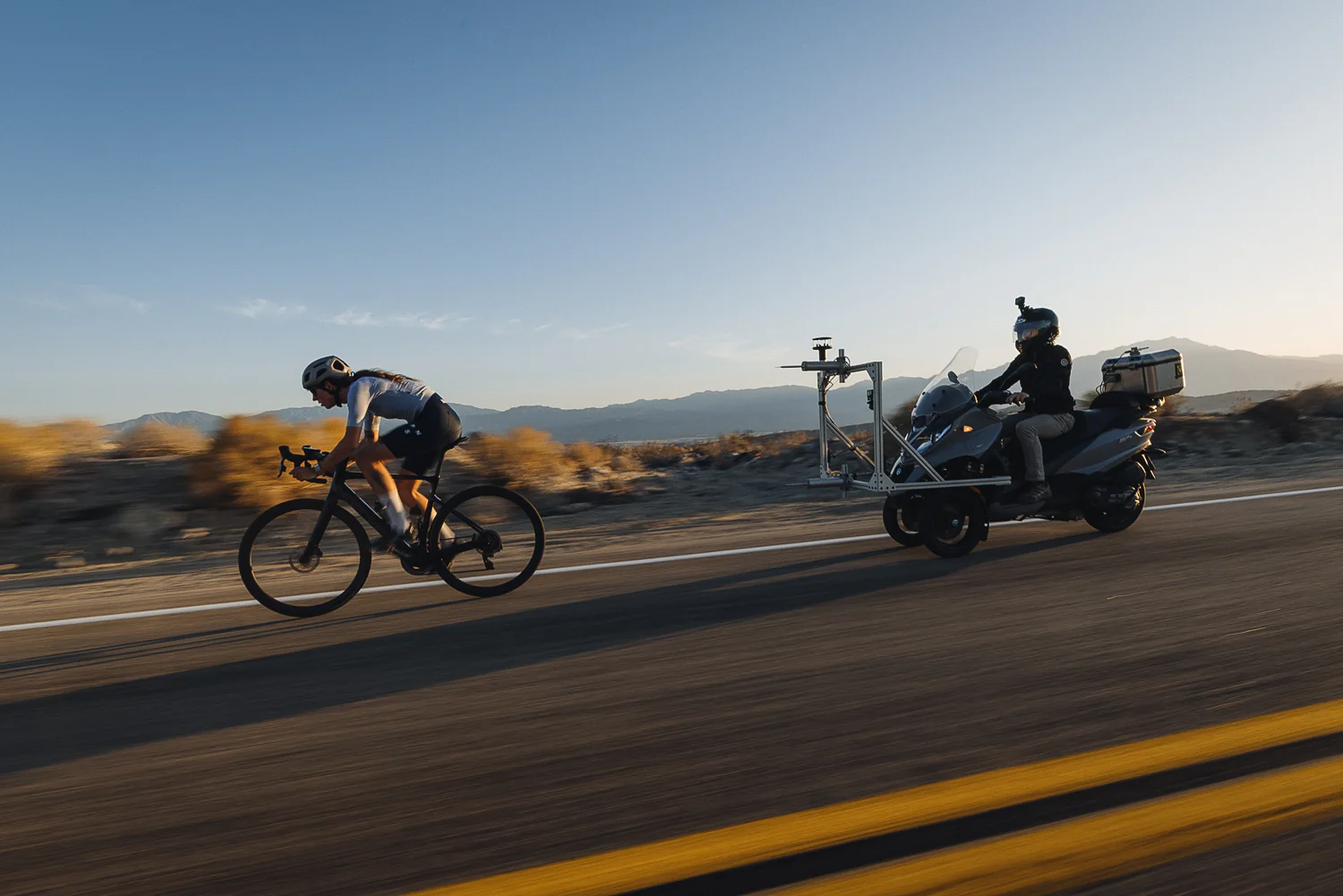
Weight and complexity of the equipment interfered with the rider’s ability to actually ride the bike.

We mounted to a three-wheeled scooter purchased in Europe and imported to the US.

The sensors collected a wide variety of information, including air temperature, air pressure, barometric pressure, wind speed and wind direction.

We had some internal expertise (one of our manufacturing engineers Joe Doty) who basically built an application from the ground up to get us what we needed.

The third step in the process was to use the data we collected to program the wind tunnel in order to replicate the turbulence found in the real world. We used a new-to-the-bicycle industry wind-tunnel created by a Guelph, Canada-based engineering company, RWDI. RWDI is an authority on wind engineering for tall skyscrapers and landmarks. One of the more noteworthy stories about RWDI describes their project to eliminate resonating sound on the Golden Gate Bridge. In that particular case, RWDI captured actual wind conditions on the bridge itself and built an identical scale-shifted model which they used to replicate wind conditions in their tunnel.

We designed multiple shapes and profiles of different rims which we 3D printed to iterate quickly through different designs, proposing, testing and proving/disproving hypotheses prior to opening up tooling on the rims. The goal, of course, was to reduce overall drag, but we also focused heavily on improving stability.

In general, taller profile rims allow for lower drag and thus aerodynamic advantage over a shorter profile, so one might think a taller profile always makes sense (to improve efficiency).

Crosswinds on a front wheel have a direct effect on steering, so it’s all about finding the balance between low drag and crosswind stability. By making the front wheel profile slightly shorter, wider, and rounder lessens the effects of crosswinds at the handlebars, increasing front end stability across all wind conditions.

The rear wheel, on the other hand, has design parameters VERY different to those of the front wheel. Steering input is a non-issue with a rear wheel. The rear wheel is partially shielded by the frame and rider. Air is channeled over the bike and rider, reducing the effect of that crosswind. This completely changes aerodynamic conditions the wheel needs to perform in.

The rear wheel is taller and narrower than the front which reduces overall drag. A taller rim means more material, so the focus is on finding the balance that avoids unnecessary weight. Lastly, the 63 in this case has an asymmetrical profile, offset away from the cassette, to create a stronger, stiffer and more durable wheel.
The results of Turbulent Aero speak for themselves. Accomplishments in the Pro Peloton in 2023 with Team Visma-Lease a Bike are solid proof of the project’s effectiveness.

That said, our engineers haven’t claimed victory over turbulence yet. There’s a ton more data to collect across different riding conditions, and more (many more) rim profiles to test.
